
95.62%. That is roughly what Royal Express: Hold and Win hands back over the long haul, give or take a hundredth of a point, and it sits about a third of a percent under the 96% figure most players treat as the waterline. Small gap, real consequences. On a medium-high variance slot capped at x1,000 that shortfall shapes the entire session, because the game leans hard on a rare bonus to deliver its return. What follows is strictly the numbers side: house edge, what 95.6% means over time versus over one night, the murky 96.11% caveat, and how the swings collide with that x1,000 ceiling. I ran the Playson demo with 11,000 credits to sanity-check the feel against the published maths.
The headline return: 95.62-95.64%
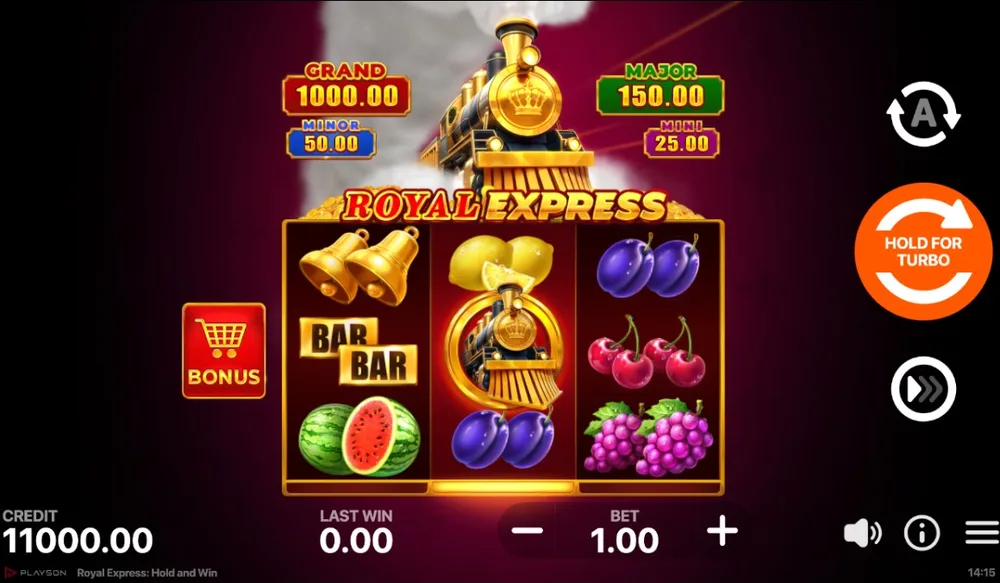
Return to player is the theoretical payback measured across a colossal sample. At 95.62% the model gives back about $95.62 of every $100 wagered and keeps roughly $4.38 as house edge.
Two things bite here. That average only materialises across millions of spins, so no single evening obeys it, and mine certainly didn’t. I also couldn’t settle which reading is canonical: the sources wobble between 95.62% and 95.64%, a hundredth of a point that’s just rounding noise between one studio spec and some aggregator’s transcription. Either way, you’re looking at a house edge in the low-4% range, which is the figure that actually matters for what the game costs you to play.
How does that stack up against the field? The modern benchmark hovers near 96%, and a good chunk of releases clear 96.5%. At 95.62% Royal Express trails, quietly but measurably. That’s not a warning label. Plenty of games I enjoy live in the 95-96% band. But if raw payback is your first filter, this one isn’t topping the list.
| Reference point | Approx. RTP | Gap vs Royal Express |
|---|---|---|
| Royal Express (headline) | ~95.62-95.64% | baseline |
| Typical Playson release | ~95.5-96% | roughly level |
| Common modern market norm | ~96% | ~0.4% richer |
| Higher-paying releases | 96.5%+ | ~0.9%+ richer |
Playson’s own catalogue tends to cluster in that mid-95 to 96 range, so Royal Express is on-brand for the studio rather than an outlier. It’s the wider market norm of 96% it slips beneath.
What about the 96.11% version?
A few databases float a 96.11% build. Understand it, don’t swallow it whole.
Studios routinely ship a single slot in several configurations, and the operator picks which one to run: one standard model, plus trimmed or occasionally boosted variants. A 96.11% listing hints that a richer setup exists somewhere out there. I couldn’t confirm it runs live at any specific casino, though, let alone by default.
So don’t assume you’ve landed on the generous build. Open the info panel wherever you sit down and read the declared number, because that’s the only one steering your actual spins. If it prints 95.62%, that’s your reality no matter what an aggregator claims. File 96.11% under maybe, not promise.
Medium-high variance, in practice
Variance describes the shape of the wins, not their eventual total. Medium-high sits the needle between a low-swing drip-feed and full feast-or-famine. In my demo runs that meant genuine droughts on the 3x3 grid, stretches where the five fixed lines barely twitched, broken up by the Hold and Win respin round doing almost all the heavy lifting. Over time the return converges on 95.6%, but the path there is lumpy, and the lumps are what empty a balance before the average ever shows up. Your credits drift down, a feature claws them back, then they drift again. A cold patch isn’t the game breaking. It’s the variance doing exactly its job.
Here’s the practical fallout of that shape:
- Most of the payback hides inside the bonus, so long gaps between triggers hurt more than they would on a gentle slot.
- Deep droughts are normal, not a malfunction, and the demo served me plenty.
- Run out of spins before you reach the feature and you bust before the game ever shows its hand.
The takeaway is simple. On this variance tier, survival to the bonus is the whole ballgame.
How many spins does a $50 or $100 bankroll actually buy?
Numbers make this concrete. The stake band runs $0.20 to $100, so right-sizing your bet is easy, and at the small end your funds stretch a long way. The table below is a rough guide to how many base spins you get before variance and the house edge grind you down (real results will swing either side of these).
| Bankroll | Bet size | Approx. base spins |
|---|---|---|
| $50 | $0.20 | ~250 |
| $50 | $0.40 | ~125 |
| $100 | $0.20 | ~500 |
| $100 | $0.40 | ~250 |
Those are gross spin counts before wins recycle, so in practice you’ll get more turns than the raw division suggests, since payouts feed back in. The point stands regardless. Betting $0.20 to $0.40 on a $50 or $100 roll keeps you in the chair far longer than blasting $2 a pull, and on a slot where the return lives inside a scarce feature, longevity is the thing you’re buying. None of it nudges the underlying 95.6% one iota, mind you. Bet sizing changes how long you last, not what you get back.
Hit frequency: unpublished
One number I flat couldn’t verify is the hit rate, meaning how often any win, or the bonus specifically, lands. Playson doesn’t appear to print an official figure.
My only marker is anecdotal. One reviewer clocked roughly one bonus per 150 spins, which loosely tracked what I saw in the demo, but that’s a single unofficial reading and not a certified stat. Don’t build tactics on it. The honest summary is that the trigger is rare enough that a padded balance and some patience beat impatience every time.
The x1,000 ceiling versus the swings
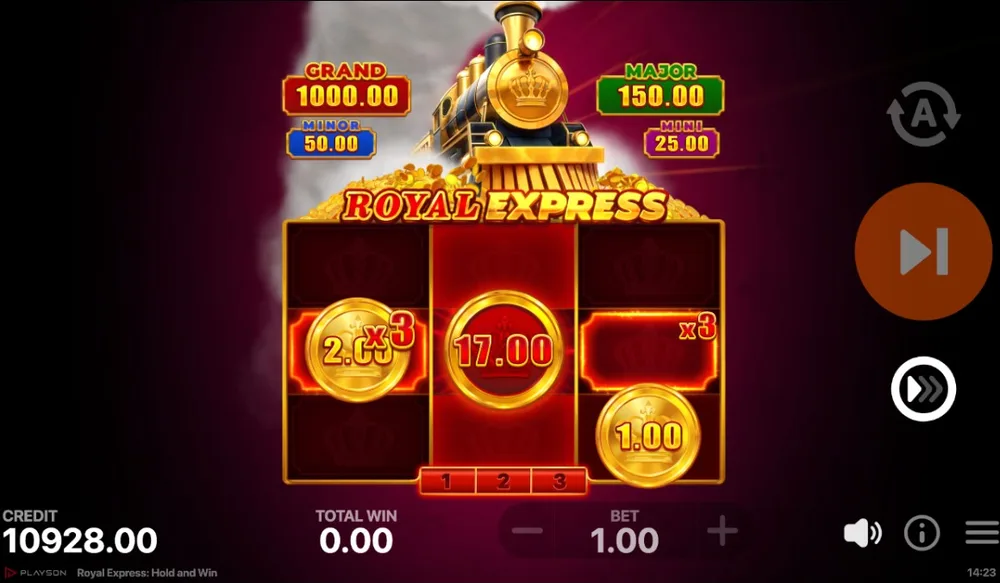
This is where the maths gets interesting. Normally variance and top prize climb together: a wild slot punishes you through long droughts and repays with a towering ceiling, so the pain buys a shot at something huge. Royal Express runs medium-high yet tops out at just x1,000 through the GRAND jackpot. That’s a slim cap for this much swing, and the bargain tilts against you a touch, because you absorb real variance without the outsized reward that usually justifies it.
It’s not fatal to the game. The four-tier ladder (GRAND x1,000, MAJOR x150, MINOR x50, MINI x25) lets the bonus pay well below the summit, and the lower rungs surface far more often than the GRAND ever will. Just calibrate honestly: mathematically this is a slot about reaching a fun feature and hoping a jackpot tier drops, not about chasing a life-changer. For how the ladder pays see the max win and jackpots page, and the Hold and Win bonus page covers the trigger mechanic itself.
Where the maths falls short
The payback is the soft spot, plainly. A 95.62% headline sits measurably under the 96% norm, and a leaner return just means the house pockets more with time. Set that against a x1,000 cap and a rare, unpublished trigger, and the proposition lands middling: you shoulder medium-high swing without the fat top prize that ought to reward it. Add the blanks (which reading is canonical, whether 96.11% is genuinely live anywhere, the missing hit rate) and there’s more to take on trust than I’d like. That doesn’t make it a bad release. It makes it one to play for the feature, not the figures. The main Royal Express review carries the overall verdict, the how to play guide walks the mechanics, and the strategy guide handles bankroll tactics.
One responsible-play note. Payback is a long-run average, never a session promise, and no system beats the edge. Strictly 18+, so set a budget you can afford to lose and quit when the fun does.
Frequently Asked Questions
Is 95.62% a good RTP?
It sits slightly below average. With the modern norm near 96%, Royal Express hands back a shade less over time. It’s a fair, playable number, just not a standout, and payback is only one lever alongside variance and the bonus.
Which RTP will I actually get?
Whatever the casino’s info panel declares. Studios often ship several configs, so a 96.11% version may exist somewhere, but I couldn’t confirm it running anywhere live. Trust the in-game notice over any aggregator listing.
How often does the bonus trigger?
Playson publishes no official hit rate. One reviewer logged roughly one bonus per 150 spins, which echoed my demo, but it’s anecdotal. Plan for a scarce trigger and bankroll for the wait rather than leaning on that figure.